


Pioneering the Future of mRNA Therapeutics

Crafton Biotechnology is developing high-purity mRNA medicines designed to improve therapeutic performance and clinical translatability. mRNA has emerged as one of the most transformational therapeutic modalities in biotechnology, but broader application beyond infectious disease vaccines requires continued progress in mRNA quality, delivery, tolerability, repeat dosing, and manufacturing speed.
Founded by leading RNA scientists from Nagoya University and Institute of Science Tokyo, Crafton is building proprietary technologies to address these bottlenecks and enable next-generation mRNA therapeutics.
Remaining issues of mRNA vaccines and therapeutics
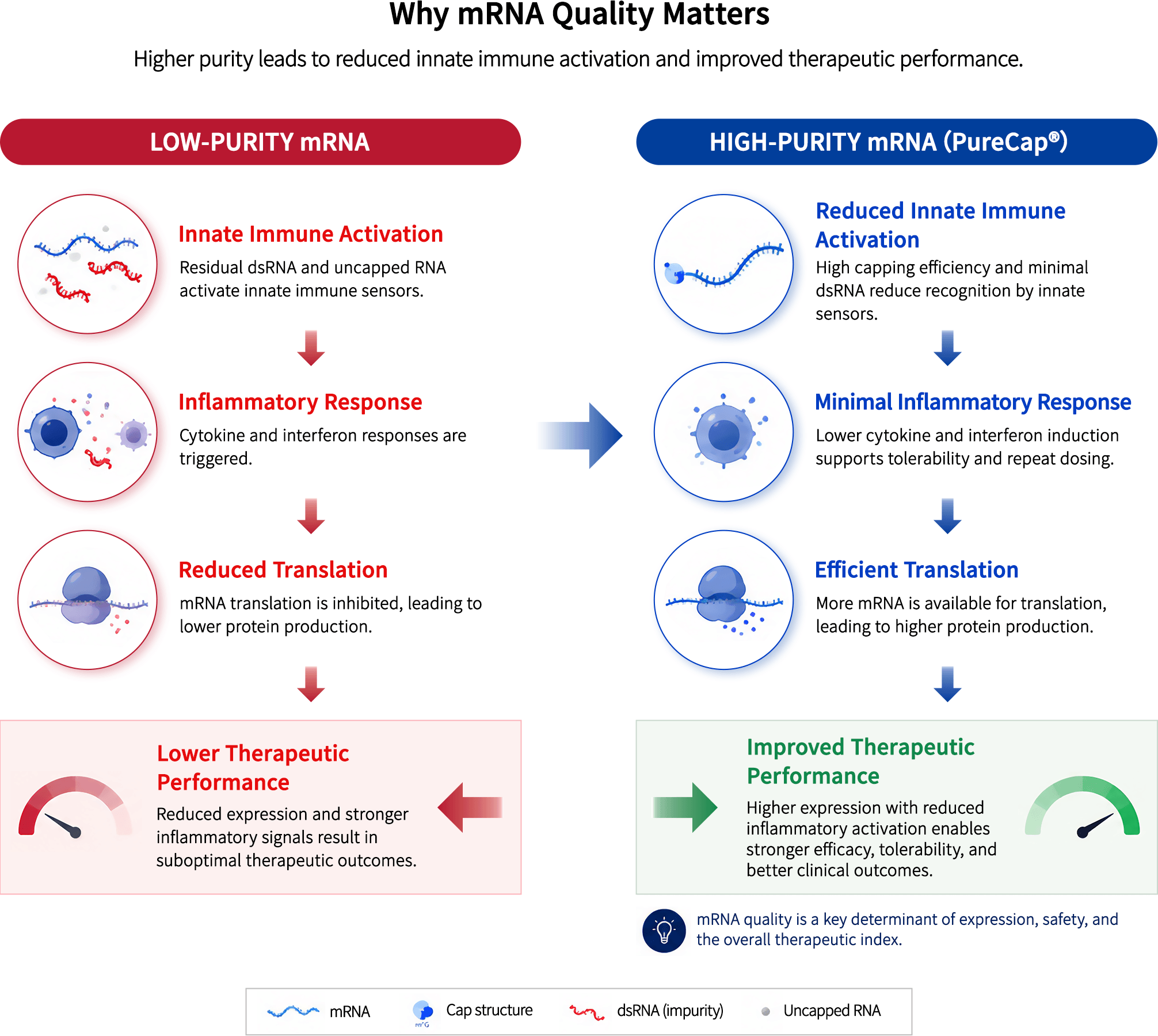
mRNA medicines have been clinically validated, but several challenges remain as the field expands beyond prophylactic vaccines into oncology, rare disease, immunology, and chronic or repeat-dose applications.
Key challenges include:
- mRNA quality and impurities
Incomplete capping, residual dsRNA, and other process-related impurities can contribute to unwanted innate immune activation and reduced translational performance. - Therapeutic index
Many future mRNA medicines may require higher doses, repeated dosing, or use in more sensitive patient populations, increasing the importance of purity, tolerability, and dose efficiency. - Delivery limitations
LNPs are clinically proven, but different disease applications may require different delivery profiles, tissue localization, or safety characteristics. - Manufacturing speed and scalability
Rapid, reproducible, high-quality mRNA production remains essential for personalized medicine, pandemic preparedness, and therapeutic development. - Clinical translatability
Platform improvements must translate into measurable benefits such as higher expression, lower inflammatory signaling, improved repeat dosing, or better manufacturability.
Crafton’s approach is to improve mRNA therapeutic performance through high-purity RNA production, application-specific delivery strategies, and advanced RNA synthesis technologies.
Crafton’s mRNA Technology Platform
PureCap®
PureCap® technology delivers <0.1% dsRNA content and >99% capping efficiency, setting industry-leading standards for mRNA quality.
By improving critical quality attributes such as capping efficiency and dsRNA reduction, PureCap® is designed to support:
- High mRNA purity
- High capping efficiency
- Reduced unwanted innate immune activation
- Improved translational performance
- Scalable manufacturing
- Compatibility with multiple delivery approaches
PureCap®technology is protected by Crafton’s proprietary intellectual property, including WO2023/282245 A1
Delivery
Crafton evaluates delivery approaches based on the biological and clinical requirements of each program. While LNPs remain an important and clinically validated delivery modality, certain applications may benefit from localized or LNP-free delivery.
Crafton’s jet injector approach is being developed as an LNP-free intradermal delivery option designed to:
- Enable localized administration of naked mRNA
- Reduce reliance on complex lipid formulations
- Support intradermal immune targeting
- Simplify selected vaccine and public-health applications
- Provide an alternative route for applications where LNP-free delivery may be advantageous
In partnership with SCARDA (Strategic Center of Biomedical Advanced Vaccine Research and Development for Preparedness and Response) Crafton is advancing a non-LNP mRNA vaccine program toward clinical evaluation.
CRAFT
Constructed RNA with Advanced Functional Technology, or CRAFT, is Crafton’s chemical RNA synthesis platform designed for short mRNA sequences and specialized RNA applications.
CRAFT enables:
- Chemical synthesis of short mRNA sequences
- Reduced dependence on DNA templates for selected constructs
- Site-specific chemical modification
- Rapid production timelines
- Exploration of modified RNAs with enhanced stability or translation
CRAFT may reduce production timelines for selected short mRNA constructs by eliminating DNA-template preparation and enabling rapid chemical synthesis.
FAQ
Q : What makes PureCap different from traditional mRNA capping methods?
A : PureCap uses Crafton’s proprietary cap and purification approach to enrich highly capped mRNA and reduce dsRNA content. By improving critical quality attributes such as capping efficiency and impurity profile, PureCap is designed to support improved translational performance and reduced unwanted innate immune activation.
Q : Why is mRNA purity important?
A : mRNA impurities, including residual dsRNA and uncapped RNA, can activate innate immune pathways. This may reduce productive protein expression and contribute to inflammatory responses. Higher-purity mRNA may be especially important for applications requiring higher doses, repeat dosing, or sensitive patient populations.
Q : Is Crafton’s jet injector intended to replace LNP delivery?
A : No. Crafton uses an application-specific delivery strategy. LNPs are clinically validated and may be appropriate for certain programs. Jet injection is being developed as an LNP-free intradermal delivery option for selected applications where localized delivery, simplified formulation, or needle-free administration may provide advantages.
Q : How does CRAFT reduce manufacturing timelines?
A : CRAFT uses chemical synthesis approaches for selected short mRNA constructs, reducing reliance on DNA-template preparation and enabling rapid design-build-test cycles. This may shorten production timelines for specific RNA applications.
Q : Can Crafton’s platforms be used together?
A : PureCap and Crafton’s delivery technologies can be combined where appropriate. CRAFT is focused on chemically synthesized short mRNA constructs and may be used for specialized applications. Crafton selects the most appropriate technology combination based on the biological and clinical requirements of each program.
Reference
- R. A. Husseini, et al., Use of Iontophoresis Technology for Transdermal Delivery of a Minimal mRNA Vaccine as a Potential Melanoma Therapeutic. Biol. Pharm. Bull., 2023, 46, 301-308.
- S. Uchida et al., Carrier-free mRNA vaccine induces robust immunity against SARS-CoV-2 in mice and non-human primates without systemic reactogenicity, Molecular Therapy 2024.
- N. Abe, et al., Complete Chemical Synthesis of Minimal Messenger RNA by Efficient Chemical Capping Reaction. ACS Chem. Biol., 2022, 17, 1308-1314.
- S. Uchida, et al., Designing immunostimulatory double stranded messenger RNA with maintained translational activity through hybridization with poly A sequences for effective vaccination. Biomaterials, 2018, 150, 162-170.
- D. Kawaguchi, et al., Phosphorothioate Modification of mRNA Accelerates the Rate of Translation Initiation to Provide More Efficient Protein Synthesis. Angew. Chem. Int. Ed., 2020, 59, 17403-17407.
- Iwai et al., Position-specific ORF nucleoside-ribose modifications enabled by complete chemical synthesis enhance mRNA stability and translation. Nat. Commun., 2025, 16, 9995.
- H. Abe et al., Cap analogs with a hydrophobic photocleavable tag enable facile purification of fully capped mRNA with various cap structures, Nature Communications 2023, 14, 2657.
- T. A. Tockary, et al., Comb-structured mRNA vaccine tethered with short double-stranded RNA adjuvants maximizes cellular immunity for cancer treatment. PNAS, 2023, 120, e2214320120.
- Kawaguchi et al, Highly pure mRNA vaccine provides robust immunization against P. aeruginosa by minimizing type I interferon responses, J. Controlled Release, 2025, 383, 113860.